
01What a thread lift is
A thread lift places absorbable threads into the tissue layer beneath the skin. The physician determines the position, the direction and the number of threads.
The threads in common use are made of PDO (polydioxanone), the same material family as the surgical suture used in medicine for decades. The body breaks this material down on its own over time.
Two things are happening, and they are worth separating. The first is mechanical support: threads with barbs or a screw texture grip the tissue, which lets the physician move descended tissue back in the intended direction.
That part is visible sooner, and it is also the part that diminishes as the threads resorb. The second is a biological response: the presence of a material the body tolerates prompts repair and collagen formation around each thread.
That part builds over weeks to months, and it is why skin can still feel firmer after the threads themselves are gone.
The two run on different timescales. That is the reason what you see on day one and what you see in month three are not the same thing.


02What it helps, and what it does not
This is the section worth reading slowly.
It can help with tissue at the cheek and jawline that has begun to descend, a jawline that reads less defined because tissue has shifted, skin under the chin that has lost firmness, and skin where collagen stimulation is wanted alongside repositioning.
What it does not do matters as much. It is not weight loss and does not reduce body fat.
It does not replace surgery in cases where laxity exceeds what threads can support. It does not change bone structure — the shape of a jaw or a cheekbone you were born with.
It does not treat skin conditions such as melasma, freckles, pore size or fine surface lines, which need a different approach. And it is not suitable for everyone; a physician may advise against it.
Knowing what a procedure is not is as important as knowing what it is, because most dissatisfaction after an aesthetic procedure comes from expectations that did not match at the outset, rather than from the procedure itself.
03Thread types, and how they differ
Threads used in lifting differ along several dimensions, and each design is intended for a different job.
- Material — PDO, PLLA or PCL. They differ in how long the material remains in the tissue and in the pattern of collagen stimulation.
- Shape — smooth (mono) versus screw or cog. Smooth threads emphasise tissue stimulation across an area; barbed and screw threads emphasise grip and repositioning.
- Depth — superficial, mid or deep. Different layers give different results and carry different risks.
- Area — cheek, jawline, under-chin, brow, neck. Each has its own anatomical constraints.
04The procedure, start to finish
In practice a physician is not choosing the best thread. They are choosing the thread that suits the problem, the tissue layer and the history of the person in front of them, and often more than one type is used in a single face.
- Physician assessment — facial structure, skin elasticity, health history, current medication, and any previous procedure in the same area, including filler or other implanted material.
- Discussion of the alternatives — including approaches that are not thread lifting, and the option of doing nothing for now.
- An explanation of limits and risks. If this step is skipped, ask for it.
- Planning the entry points — the direction of lift and the number of threads.
- Skin cleansing and local anaesthesia.
- The procedure, performed by a physician.
- A follow-up appointment, on the schedule the physician sets rather than the one an advertisement sets.
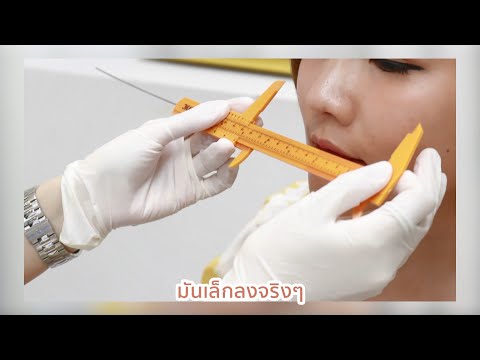

05Results and duration — what can honestly be said
What nobody can tell you accurately in advance is how much change you will see, or how long it will last. It depends on age and skin elasticity, on the quantity and quality of tissue in the treated area, on the type and number of threads, on technique and the layer they are placed in, on behaviour afterwards — sleep, facial expression, a change in body weight — and on individual genetics and how quickly a person breaks the material down.
Only two things can be said with certainty. The threads resorb naturally over time, and the collagen effect diminishes gradually with age.
And no aesthetic procedure gives a permanent result; no one can guarantee an outcome in advance.
If you encounter advertising that states a percentage figure, or uses the word permanent, treat it as a warning sign.
06Risks and what to watch for
Every procedure that introduces material into the body carries risk. Knowing in advance is not there to frighten you; it is there so you know when to call the clinic.
Common in the early period: swelling, bruising, tightness, tenderness at the treated area, temporary unevenness, and a pulling sensation when moving the face.
- Contact the clinic immediately if pain increases rather than settles.
- Contact the clinic if there is unusual redness, heat or swelling, or a fever.
- Contact the clinic if there is discharge from an entry point.
- Contact the clinic if the skin dimples, creases persistently, or you can feel a thread at the surface.
- Contact the clinic if the two sides of the face are clearly asymmetric once swelling has settled.
07Compared with the alternatives
A thread lift is not the only answer and is not superior to the alternatives. Each approach addresses a different dimension of the same complaint.
Thread lifting repositions tissue and stimulates collagen, and suits skin that has begun to descend while retaining elasticity. HIFU (focused ultrasound) tightens deeper layers with heat, introduces no material, and works gradually.
Radiofrequency such as Thermage or Oligio works on the dermis and emphasises skin quality and firmness. Collagen stimulators increase tissue density over a longer horizon and are usually given as a course.
Filler restores volume where it has been lost, which is a different problem from lifting. Surgery addresses excess skin beyond what a non-surgical approach can hold, and belongs in the conversation.
Often the appropriate plan combines approaches rather than choosing one, and that decision should come from an assessment of the actual face, not from a short clip or an online message.

08Questions to ask your physician
Keep these five on your phone and ask them at the consultation.
- What will this procedure help with on my face, and what will it not help with?
- Why does it suit my facial structure and my history in particular?
- What are the alternatives, including doing nothing for now?
- What are the risks that apply to me, and what warning signs should I watch for?
- How does this plan affect my travel, my work or my exercise schedule?
Ready to talk to our doctor?
Send a photo or describe your concern on LINE — we'll suggest a treatment plan and price range before you visit.
09Common questions
Does a thread lift make the face smaller?+
A thread lift lifts and repositions tissue. It does not reduce the amount of fat. What changes is the shape and firmness of the jawline, and that differs from person to person.
Does it hurt?+
Local anaesthesia is used during the procedure. Tightness or tenderness at the treated area in the early period is common. How much a person feels varies.
How long is the recovery?+
It depends on technique, the number of threads and individual skin. Do not assume that every non-surgical procedure means no recovery time. Ask your physician before planning anything important or booking a flight.
Will I need to repeat it?+
The threads resorb naturally. Maintaining the result may require an ongoing plan, which a physician assesses individually.
Can a thread lift replace surgery?+
Not in every case. Where laxity is advanced, thread support may not be sufficient. A physician assesses which approach is appropriate.
At what age should someone start?+
There is no fixed number. The decision should come from the condition of the tissue and what the individual wants, not from age alone.