
01Marks versus scars
What remains after acne falls into two categories sitting in different layers. A mark is a change in skin colour — the surface is still smooth, only the shade differs.
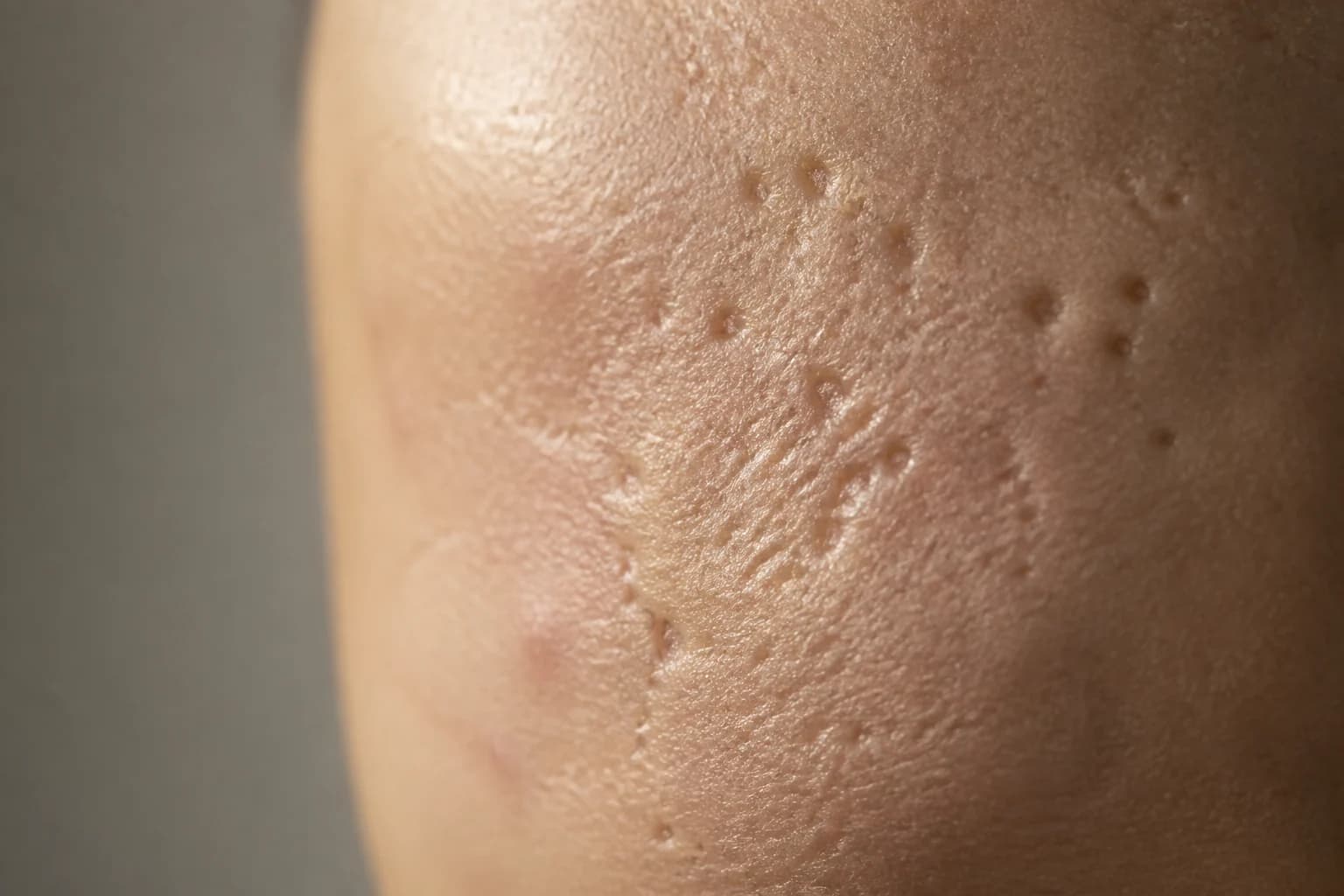
A scar is a change in shape: collagen and tissue have genuinely been lost, so the skin dips.
That difference decides everything downstream. The body clears colour on its own — pigment breaks down, dilated vessels constrict — but collagen destroyed by severe inflammation is not naturally rebuilt to refill the depression.
A test you can do yourself: light the area from an oblique angle. If a shadow falls inside it, the skin is genuinely depressed — a scar.
If the surface stays smooth and only the colour differs, it is a mark. Lighting the face straight on hides the difference, because direct light erases the shadow.
02Red marks versus brown marks
Marks themselves divide in two, and the difference is mechanical rather than cosmetic.
Red or pink marks come from capillaries left dilated after inflammation; pressing usually blanches them briefly. Brown marks come from pigment overproduced during the inflammation; pressing does not change them.
A Thai split-face study of acne treatment scored post-acne erythema and post-inflammatory hyperpigmentation as separate measures — reflecting that these are distinct phenomena that behaved differently across the twelve-week course.
Both fade, on different timelines, and the single largest variable slowing them is sun exposure. Post-inflammatory pigmentation is highly sun-sensitive, so photoprotection is not general advice here — it is the difference between three months and twelve.
03The three scar types
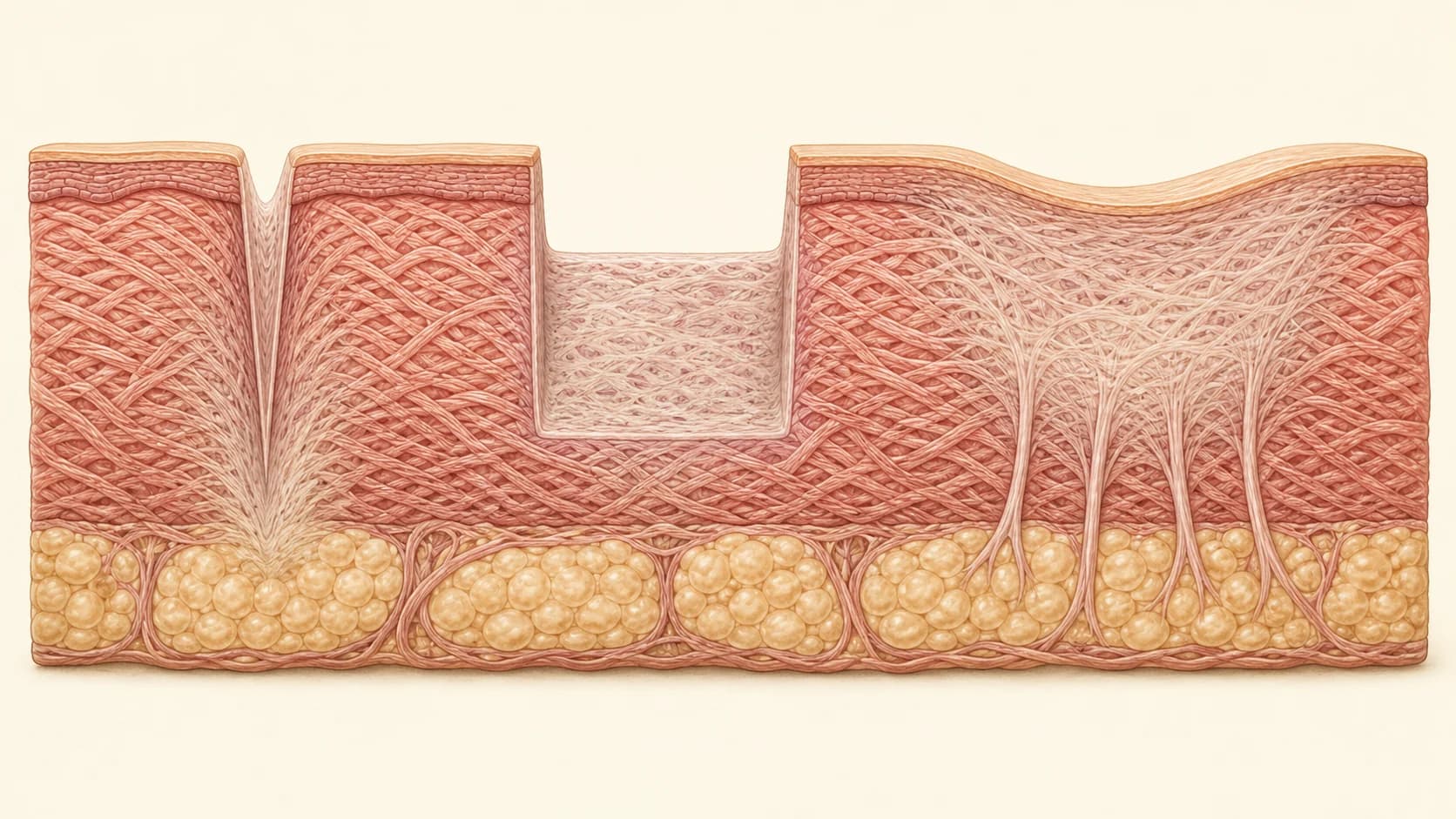
Reviews use a classification of atrophic acne scars into three types. It is the standard framework in dermatology, and it explains why two people 'with acne scars' get very different results from the same approach.
Ice pick
Boxcar
Rolling
Most people have more than one type on the same face. Real assessment uses oblique lighting and palpation; classifying yourself from a photo is unreliable.
04What each technology class does
The 2019 review built on that classification catalogues the studied approaches: subcision, punch excision and elevation, injectable fillers, chemical peels, dermabrasion, microneedling, and energy-based devices — noting a decade-long trend towards fillers and energy-based devices.
Why the approach must match the type comes down to the depth each one reaches. Rolling scars tethered by fibrous bands beneath the skin need that tethering addressed, not the surface.
Narrow deep ice pick scars are the most challenging shape, because approaches that treat broad areas do not reach a narrow base.
Energy-based procedures — fractional laser, or radiofrequency delivered through fine needles — work by creating controlled micro-injuries in the skin to prompt new collagen where it was lost. That suits scars needing volume rebuilt from within, more than scars with a mechanical cause such as tethering.
The same review is candid that high-quality evidence here is scarce and that many studies leave the scar type undefined, which makes comparing approaches difficult. That is exactly why individual assessment outranks copying what worked for someone else.
05Realistic expectations
The most direct statement in the literature is that acne scars can be improved by a variety of medical or surgical methods but never entirely reversed. The realistic goal is reducing how visible a scar is and smoothing how light falls across it — not erasure.
Practically, that means multiple sessions, often more than one approach combined according to the scar types present, with results appearing over collagen-remodelling cycles measured in months rather than weeks.
The highest-return action is therefore not correcting scars later but settling active inflammation early, because scars form where inflammation destroys collagen. Longer and more severe inflammation means more scarring — and squeezing or picking adds inflammation directly.
This article is general information, not a diagnosis or individual treatment advice. Topical and oral acne medicines are prescription decisions requiring physician assessment and follow-up.
Ready to talk to our doctor?
Send a photo or describe your concern on LINE — we'll suggest a treatment plan and price range before you visit.
06Common questions
Do acne scars fade on their own?+
No. A scar is lost collagen and tissue, not a colour change the body can resolve — unlike marks, which do fade. Waiting for a scar to fill in produces no result.
Can acne scars be completely cured?+
They can be improved but not fully reversed. The literature states plainly that acne scars are improved by medical and surgical methods yet never entirely returned to normal skin.
Reducing visibility is the realistic goal.
How many types of acne scar are there?+
The standard classification divides atrophic scars into ice pick (narrow, deep), boxcar (sharp-edged, flat-floored) and rolling (indistinct edges, undulating). Each responds differently, and most people have more than one type.
How long do acne marks take to fade?+
There is no fixed figure. It depends on whether the mark is red or brown, how severe the original inflammation was, baseline skin tone, and above all sun exposure — post-inflammatory pigmentation is highly sun-sensitive, so photoprotection changes the timeline several-fold.
Does extraction help with acne scars?+
Not directly. Professional extraction manages existing comedones; it does not correct scars or marks already formed.
The connection is preventive: settling acne quickly reduces new scarring, while squeezing at home increases inflammation and scarring risk.
How many laser sessions do acne scars need?+
There is no standard number — it depends on scar type, depth, area and individual response. Expect several sessions with results appearing over collagen-remodelling cycles of months.
Ask about the whole plan and its review points rather than the per-session price.
07Visual gallery
08References & further reading
- Boen M, Jacob C. A Review and Update of Treatment Options Using the Acne Scar Classification System. Dermatol Surg. 2019;45(3):411–422.Atrophic acne scars divide into icepick, rolling and boxcar types. Therapies span subcision, punch excision and elevation, injectable fillers, chemical peels, dermabrasion, microneedling and energy-based devices — with f…
- Jansen T, Podda M. Therapy of acne scars. J Dtsch Dermatol Ges. 2010;8(Suppl 1):S81–S88.Once the scar type is defined, appropriate treatment can be offered — but acne scars can be improved by medical or surgical methods and never entirely reversed. Erythema and, less often, pigmentary change may accompany t…
- Kaewsanit T, Chakkavittumrong P, Waranuch N. Clinical Comparison of Topical Treatments in Mild to Moderate Facial Acne Vulgaris. J Clin Aesthet Dermatol. 2021;14(6):35–41. (Thammasat University, Thailand)A Thai split-face study scoring post-acne erythema and post-inflammatory hyperpigmentation as separate measures — the two are distinct phenomena that behave differently over a 12-week course.
External sources · last verified 2026-08-18